How to Read a Casino Turn Sequence
Learn to read a casino turn sequence by tracing who acts, which choices open, and what ends a turn, so you can compare game rules clearly in class.
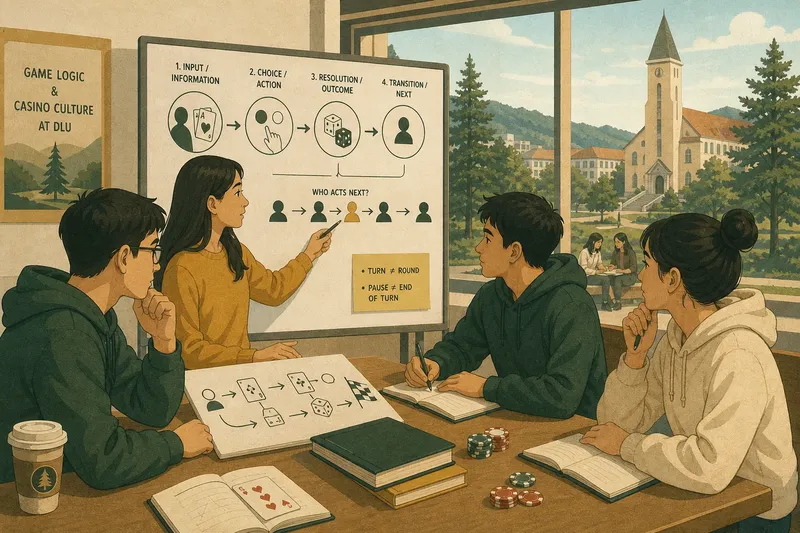
The most common mistake when reading a casino turn sequence is treating every pause as the end of a turn. That can leave you unsure who may act next and make a game’s rules harder to explain. Follow the prompts and changes in the game state instead: they show how play moves from one action to another.
For students at Trường Đại học Đà Lạt studying games and casino culture, this approach shifts attention from a dramatic result to the structure of play. A turn is like a queue at a café: the order shapes what can happen next, even when the queue briefly stops.
Read turn signals
A turn is a rules-defined stretch of play in which a participant may act, or the game may process an input, before a new stage begins. Follow the particular game’s cues: who receives a prompt, what it permits, and what changes afterwards.
In a card game, a prompt may offer a choice before the hand is settled. In a slot-style game, an input may lead directly to a result and a changed display. A pause between input and result does not, on its own, show that a turn has ended.
Track three details: the active participant, the available action, and the event that moves play forward. This separates a player’s decision from the outcome without assuming that the decision determines it.
Compare play patterns
Games distribute actions and resolutions in different ways. These patterns help with comparison, though a particular game may combine them or use different terms.
Choice before resolution
A player receives information, selects an allowed action, and then sees the hand or round resolve. The decision point is visible, but it does not control every event that follows.
For class discussion, mark the choice and identify which actions the rules permit at that moment. This keeps the discussion grounded in the sequence rather than in the result alone.
Input before resolution
Some games ask for a direct input and then process the result with few further decisions during that cycle. The sequence may feel brief, but it still has an entry point, a resolution, and a transition to what follows.
This pattern can make interface cues easier to trace. It offers fewer branches to map than a turn with several permitted actions.
Alternating actions
In an alternating format, several participants may act before the game settles a result. One person’s move can change what the next person sees or may do, so the order matters.
To keep the sequence clear, note who becomes active after each move. If the next participant’s options change, record that link rather than treating the actions as separate events.
Locate decision points
To compare two games, find the moment when a player must choose. It may come after receiving information, before a round begins, or between another participant’s actions. Then ask whether the choice changes the player’s position, the options still available, or only the move towards resolution.
Say you are discussing two invented games in a seminar. In the first, Mira receives cards, chooses whether to take another permitted action, and then watches the hand settle. In the second, she makes one opening input and the game resolves. The expected observable difference is a distinct choice to discuss in the first sequence and a more direct input-to-result transition in the second.
This distinction is more precise than calling a game “all skill” or “all chance”. A sequence can include a decision and an uncertain outcome without making the decision responsible for the result.
Recognise turn endings
The rules, not a screen pause alone, define where a turn or round closes. Look for a cue such as a new participant becoming active, a hand settling, or a fresh set of options appearing. Check that cue against the rule sheet.
One player finishing an action does not always mean the round is over. In a multi-person game, others may still need to act before the result is settled. Keep “turn” and “round” distinct unless the game’s own definitions treat them as the same.
Compare casino turns
- Check for choices after information appears: If the rules offer a permitted decision before resolution, mark that point for discussion. If they do not, map the sequence as an input followed by resolution.
- Check what the opening input does: If it starts a cycle without another decision, note the direct transition. If later choices appear, record each choice and when it becomes available.
- Check who acts next: If another participant’s move changes what follows, map the actions in order. If it changes nothing, record the move and resolution as separate events.
- Check for a stated closing event: If the rules name the end of a turn or round, use that event as the boundary. If they do not, consult the game’s definitions before marking the sequence’s end.
- Check when each prompt appears: If prompts arrive in a clear order, note what each permits. If their order is unclear, refer to the rules instead of guessing which turn they belong to.
- Check whether an action changes later options: If it changes what another player may do, map the moves as linked actions. If it does not, record the action and resolution separately.
These checks help students compare game structures without treating an outcome as a judgement on a player’s decision. They also show why two games can feel different even when both settle a round after a brief sequence.
Questions about turns?
Does every turn follow a fixed order?
Each game has an order defined by its rules, but that order varies between formats and can depend on the state of play. Follow the specific game’s instructions rather than importing an order from another one.
Is a turn the same as a round?
Not necessarily. A turn may be one participant’s opportunity to act, while a round can continue until several people have acted or a result has been settled.
Why separate an action from its outcome?
The distinction shows which part involves a player’s choice and which part is the game’s resolution. It helps you describe the mechanics without treating the result as proof that the choice was sound or unsound.
What should I read first in a rule sheet?
Start with the order of play, then identify who acts, which options are available, and what closes the turn or round. Check the game’s definitions if a term or timing rule is unclear.
Map a game sequence
When a turn is difficult to follow, write the events in order: who is active, what action is permitted, what the game resolves, and what changes next. Add a note wherever another participant acts or a prompt opens a new choice.
A casino turn sequence becomes easier to discuss when you can point to its decision points and closing cues. In a classroom reading, noting whose action comes next can be as useful as noting the result: it keeps the structure visible when the outcome draws attention.