How Casino Stories Change in the Retelling
Casino stories can change in the retelling. Learn how a narrator’s choices shape a scene and why one striking moment may not describe the whole account.
The most common mistake in reading a casino story is treating its memorable moment as the whole event; the cost is overlooking how a tale gets its shape. In a class discussion at Trường Đại học Đà Lạt, a story about a roulette result can also open a useful question: how does a familiar plot make a game feel meaningful?
Stories seek a shape
Many casino tales follow a recognisable arc: someone takes a chance, tension builds, and a result seems to settle the scene. That shape makes an anecdote easy to tell over coffee or in a seminar, but it can make a game sound like a drama with a lesson waiting at the end.
Think of a story as a paper fan. Folded shut, it has a neat outline; opened, it shows separate panels that do not all point to the same conclusion. A reader can enjoy the shape while still noticing that a dramatic ending is a storytelling choice, not a rule about how games behave.
Chance and character
Casino stories often cast people in familiar roles: the daring player, the cautious friend, the fortunate stranger. Those roles can make a scene lively, yet they also turn a choice into a character trait. One wager does not, by itself, establish that someone is brave, reckless or skilled.
For students discussing casino culture, that distinction shifts attention from judging a person to noticing the story’s design. Ask which role the teller assigns, what detail makes that role seem plausible, and whether another telling could cast the same person differently.
Plot is not a rule
A sequence of events can feel like a pattern once it has been shaped into a story. If a player chooses a colour, loses, then chooses it again and wins, the ending may invite the idea that persistence was rewarded. The sequence alone does not establish that the second choice caused the win or that repeating it is a sound approach.
This is one way casino culture travels through conversation: a vivid anecdote becomes a lesson, and the lesson can sound more certain than the tale that inspired it. Naming the difference keeps a personal story in its proper place—as a way to talk about hopes, choices and suspense, rather than a reliable method for predicting a game.
Questions readers ask?
Why do casino stories feel persuasive?
A clear character and a satisfying turn make events easier to follow and remember. That narrative strength can make a conclusion feel compelling even when the story offers no basis for applying it to another game.
Does a dramatic win reveal skill?
A result may be dramatic without showing what produced it. To discuss skill, look for evidence beyond the story’s emotional ending rather than treating a memorable outcome as its own explanation.
How can a class discuss luck?
Students can compare the language used for a lucky outcome with the language used for an ordinary one. That comparison opens discussion of how people give chance a personality or a purpose, without claiming that chance has intentions.
Can a casino story still be useful?
Yes: it can reveal what the teller finds exciting, frightening or worth remembering. Its value may lie in those perspectives, rather than in offering advice about how a game will turn out.
Read the story’s design
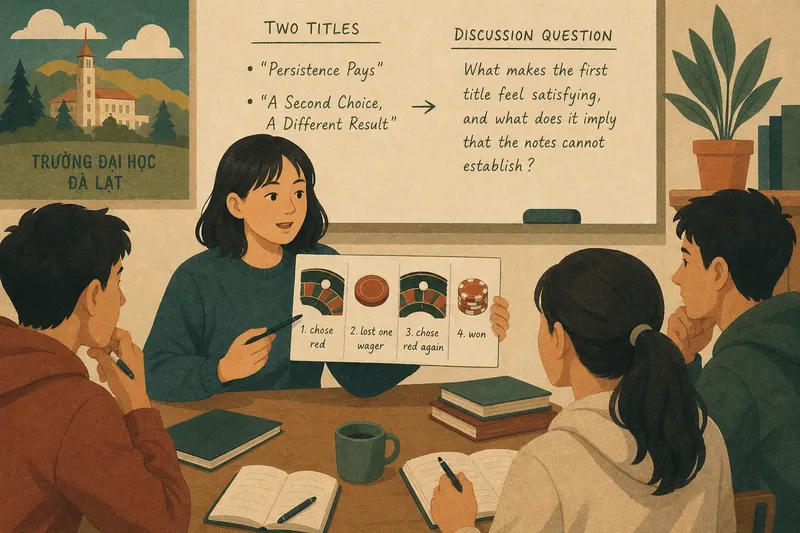
Imagine Lin, an invented student, is preparing a seminar discussion from a fictional roulette anecdote. The starting material is four notes: a player chose red, lost one wager, chose red again, then won. Lin writes down two possible titles—“Persistence Pays” and “A Second Choice, A Different Result”—and asks what each title leads a reader to expect.
Lin then groups the four notes into an opening choice, a setback, a repeated choice and an ending. The first title turns the ending into a lesson about persistence; the second keeps the sequence visible without claiming that persistence caused the result. Lin chooses the second title for the seminar handout, then adds a discussion question: what makes the first title feel satisfying, and what does it imply that the notes cannot establish?
The result is a specific classroom decision: keep the anecdote, but use it to discuss narrative framing rather than as advice about betting. The fictional notes support the order of events; they do not supply the player’s motive or a general rule.
Classroom discussion prompts
These checks help a group examine how a casino story works as a story. Each observation points to a choice about how to discuss or present it.
- Check whether the tale gives a person a role such as “fearless player”; if the role is supported by a stated action or explanation, discuss it as the teller’s characterisation, but if not, describe the action without assigning a trait.
- Check whether the ending sounds like a moral; if the story explicitly states a lesson, identify it as the teller’s message, but if it does not, avoid supplying one on the teller’s behalf.
- Check whether a win or loss carries the entire plot; if the account includes earlier events, discuss how they shape the ending, but if they are absent, call the tale a selective anecdote rather than filling in a backstory.
- Check whether the wording makes chance seem purposeful, with phrases such as “luck came back”; if that is figurative language, discuss its effect, but if the group needs a plain account, replace it with the reported result.
- Check whether a character’s choice is treated as a strategy; if the tale explains a plan, describe it as the character’s plan, but if no plan is given, do not present the choice as a proven method.
- Check whether the discussion moves from one tale to a general claim about games; if the group has a separate basis for that claim, identify it, but if not, keep the conclusion about this particular story.
Keep the lesson modest
Reading casino stories at Trường Đại học Đà Lạt can bring students closer to the language of chance, character and suspense. A useful discussion does not flatten a lively anecdote; it asks what the story invites its audience to feel and where that invitation stops short of a rule.
When you retell one, choose a title that describes the scene rather than promising a lesson, and let the ending remain an ending. That small choice preserves the pleasure of the tale without turning its plot into advice about the next game.